

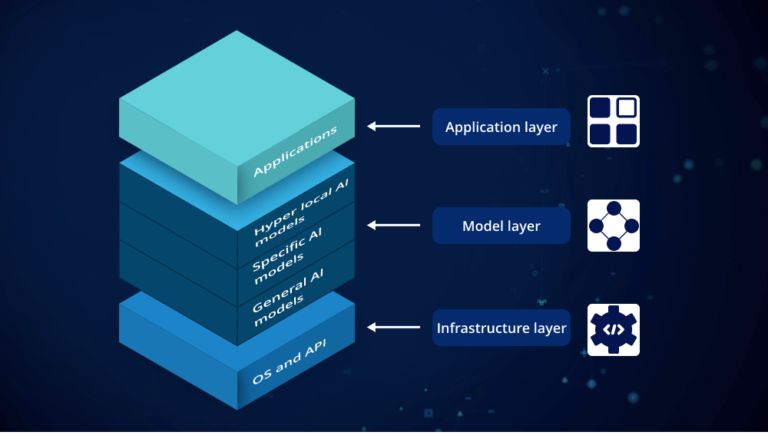
Generative AI is transforming industries at an unprecedented pace, powering everything from AI-generated medical research to autonomous diagnostics in healthcare. However, behind every breakthrough lies a robust AI infrastructure stack—the unseen foundation that enables AI models to process vast datasets, generate insights, and deliver real-time solutions.
In this post, we will explore the new Generative AI infrastructure stack, breaking down its key components, recent advancements, and what it means for MedTech startups and investors. As AI-driven healthcare solutions continue to gain traction, understanding this stack is crucial for anyone looking to harness its potential.
- Understanding the Generative AI Infrastructure Stack
The Generative AI infrastructure stack refers to the ecosystem of hardware, software, and frameworks required to build, train, deploy, and scale generative AI models. This stack consists of multiple layers, from high-performance computing to data pipelines and security protocols.
For MedTech startups leveraging AI for medical diagnostics, drug discovery, or personalized medicine, a deep understanding of this stack is essential. It determines how efficiently AI models can be trained, how fast they can process patient data, and how securely they can be deployed in compliance with healthcare regulations.
- The Core Components of the Generative AI Infra Stack
a) Compute Power: The Backbone of AI
At the heart of every AI system is compute power—the raw processing capability required to run complex neural networks.
- GPUs (Graphics Processing Units): NVIDIA’s H100 and A100 chips dominate AI training due to their parallel processing capabilities.
- TPUs (Tensor Processing Units): Developed by Google, TPUs offer specialized acceleration for deep learning workloads.
- AI Accelerators & Custom Silicon: Companies like Cerebras, Graphcore, and SambaNova are building AI-specific chips to challenge GPU dominance.
- Cloud vs. On-Premise Compute: While AWS, Azure, and Google Cloud provide scalable AI compute services, some companies opt for on-premise AI clusters for privacy and cost efficiency.
The choice of compute power significantly affects training speed, cost, and energy efficiency, making it a critical decision for AI-driven healthcare applications.
b) Data Infrastructure: Fueling Generative Models
Data is the lifeblood of AI. Without a robust data pipeline, even the most powerful AI models will underperform.
- High-Quality Data Collection: AI models in MedTech require massive datasets, including medical images, genomic data, and clinical records.
- Data Storage Solutions: Cloud-based storage (AWS S3, Google Cloud Storage) vs. hybrid and on-premise solutions.
- Data Preprocessing & Labeling: AI models require properly annotated and structured datasets—hence the rise of data-centric AI and synthetic data generation.
- Data Privacy & Security: Compliance with HIPAA, GDPR, and the EU AI Act is non-negotiable for MedTech AI startups.
c) Model Training & Optimization Frameworks
Training large-scale AI models is resource-intensive and requires specialized frameworks.
- Key AI Frameworks: PyTorch, TensorFlow, and JAX are the dominant deep learning libraries.
- Training Efficiency Techniques: Distributed training, model parallelism, quantization, and low-rank adaptation are optimizing AI workloads.
- Foundation Models & Fine-Tuning: Instead of building AI from scratch, startups are fine-tuning foundation models like GPT-4, Llama, and Gemini for domain-specific applications.
For MedTech startups, foundation models can be fine-tuned to interpret radiology scans, predict disease progression, or assist in robotic-assisted surgeries.
d) Deployment & Inference: Scaling AI for Real-World Use
Once an AI model is trained, real-time inference becomes the next challenge.
- Model Compression for Faster Inference: Techniques like pruning, knowledge distillation, and quantization reduce model size without sacrificing accuracy.
- Cloud-Based AI Services: AWS SageMaker, Google Vertex AI, and Azure AI offer managed AI deployment solutions.
- Edge AI & On-Device Computing: AI models running directly on medical devices reduce latency and improve patient data security.
For example, AI-assisted ultrasound devices leverage on-device AI to analyze scans instantly without sending data to the cloud, ensuring faster and more private diagnostics.
e) Responsible AI & Security Considerations
As AI becomes more integrated into healthcare and financial systems, ethical concerns and security threats must be addressed.
- AI Bias & Fairness: Training data must be diverse and representative to avoid biased medical diagnoses.
- Adversarial Attacks: Generative AI models are vulnerable to manipulated inputs that can lead to false results—a serious risk in medical decision-making.
- Regulatory Compliance: Governments are introducing AI governance frameworks to ensure transparency and accountability. The EU AI Act and FDA guidelines for AI in healthcare are key regulatory considerations for MedTech startups.
- The Future of Generative AI Infrastructure
The AI landscape is evolving rapidly, and several trends will shape the future of Generative AI infrastructure:
- Specialized AI Chips: Companies like Cerebras and Tesla’s Dojo are developing chips optimized for AI workloads.
- Open-Source AI Models: The rise of open-source AI (Llama, Falcon, Mistral) challenges proprietary models and promotes transparency.
- Quantum AI & Neuromorphic Computing: While still in early stages, quantum computing and brain-inspired AI architectures could revolutionize biomedical simulations and AI-powered drug discovery.
- Implications for MedTech Startups & Investors
For MedTech startups and investors, Generative AI presents a game-changing opportunity:
- AI-Powered Diagnostics: Generative models can analyze medical images, detect anomalies, and assist radiologists with greater accuracy than traditional methods.
- AI in Drug Discovery: AI accelerates biomolecule simulation and drug development, reducing research timelines from years to months.
- AI-Driven Personalized Healthcare: Generative AI can create patient-specific treatment plans, improving outcomes and reducing healthcare costs.
Investment Opportunity: Why Investors is Watching This Space
Investors believe that AI-powered MedTech startups are at the forefront of healthcare innovation. The convergence of AI and medicine will redefine diagnostics, treatment, and patient care, creating enormous value for both investors and society. MedTech founders looking to integrate Generative AI into their solutions must stay ahead of infrastructure advancements to remain competitive.
Conclusion
The Generative AI infrastructure stack is evolving rapidly, unlocking new possibilities for MedTech innovation. As AI models become more powerful and efficient, their impact on healthcare, diagnostics, and drug discovery will only grow. For MedTech entrepreneurs and investors, the time to act is now. Understanding the AI infra stack is not just a technical necessity—it’s a strategic advantage.